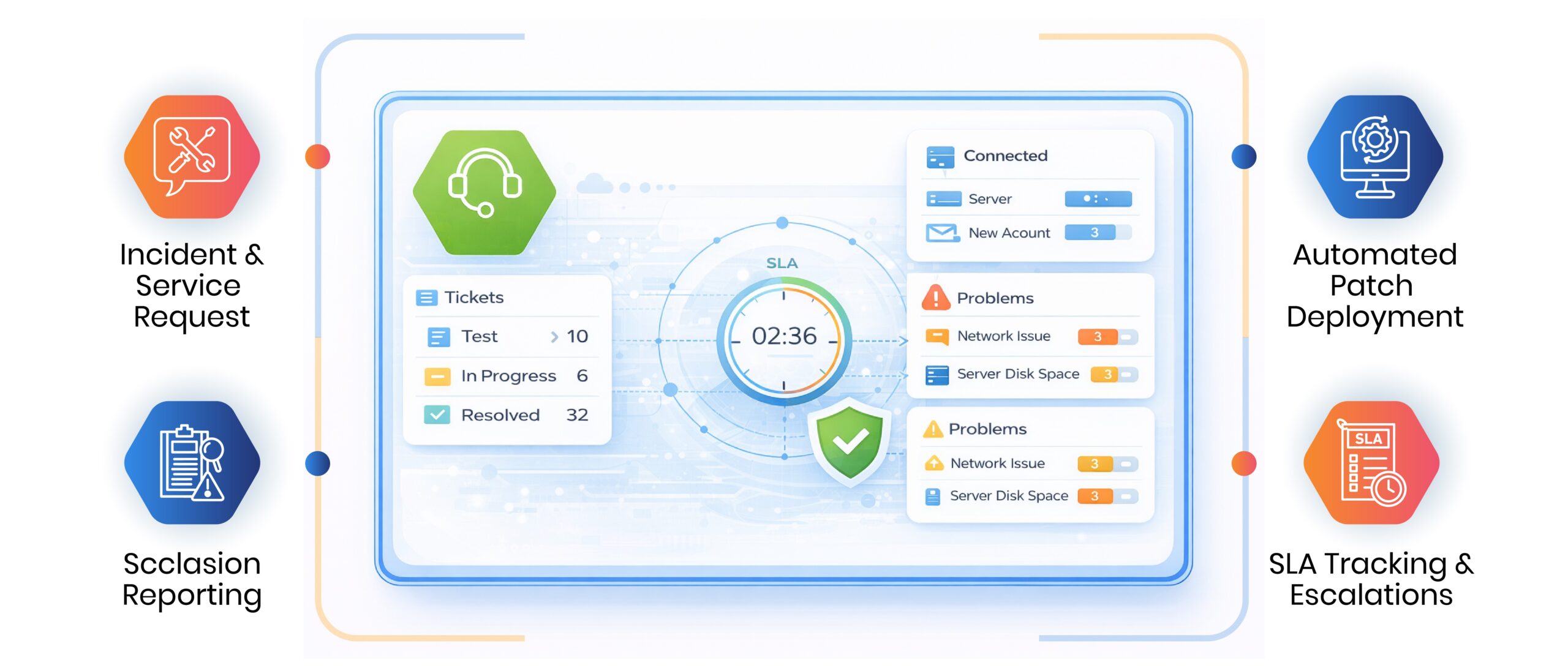
The ITSM module executes process-driven service desk operations via ITIL-standardized frameworks. This architecture bridges service delivery with operational accountability to maintain infrastructure stability.
Core ITSM
Functional Features
Unified Intake & Omni-Channel Support Interface
Unified portals consolidate support requests via email, web, plus API triggers. Single-pane views facilitate agent queue management; synchronized interfaces eliminate input latency. Audit logs capture interaction histories—maintaining immutable state capture throughout service life.
Logic-Based Workflow Configuration Engine
Visual designers facilitate custom logic paths; branching conditions trigger automated actions per ticket priority. Workflows enforce compliance via mandatory data inputs—blocking ticket advancement without valid configuration signatures. Modular architecture allows rapid logic shifts.
Real-Time Threshold Monitoring & Escalation
Precision timers track elapsed time against SLA thresholds; automated triggers notify management as breach windows approach. Visual indicators flag high-priority assets—forcing technician focus on critical uptime targets. Reporting captures breach data for reg-audit compliance.
Matrix-Driven Priority & Impact Routing
Categorization matrices calculate ticket urgency via affected user counts; high-impact events trigger emergency workflows. Logic ensures mission-critical outages receive resource priority over low-tier requests. Routing parameters remain customizable for organization-specific risk.
Event-Triggered Stakeholder Notification System
Triggers push status updates via email, SMS, plus chat protocols; notifications reduce inbound inquiries. Template-based messaging ensures consistent communication standards across support interactions. System alerts notify technicians regarding new assignments or high-priority updates.
ITAM-Integrated Asset Incident Correlation
API hooks pull real-time ITAM data to associate tickets with hardware; linkage provides device history plus configuration details. Mapping facilitates hardware lifecycle analysis. Impact tools show business service reliance on linked assets to prioritize remediation efforts.
Granular Role-Based Operational Dashboards
Visualizations provide tailored views for technicians plus executives; KPIs track queue health and agent performance. Permissions restrict sensitive data access per organizational roles. Dashboards facilitate data-driven decisions through live feeds of operational service metrics.
Tamper-Evident Audit & Compliance Logging
System action records in tamper-evident ledgers; logs include timestamps, user IDs, plus specific data modifications. Transparency ensures accountability for configuration interventions. Historical data remains retrievable for forensic analysis during post-incident investigations.
Decentralized End-User Self-Remediation Portal
Interface enables user ticket submission plus knowledge access; portal reduces desk volume via self-remediation. Intuitive search tools surface documentation based on keywords. Feedback loops allow user quality rating—driving ongoing service desk optimization logic.
ITSM Architectural
Capabilities
Incident Management
Logic-driven workflows isolate service disruptions to facilitate rapid restoration of operations.
Service Request Management
Standardized pipelines automate delivery of pre-approved hardware and software service requests.
Change Management
Risk-assessment frameworks govern infrastructure modifications to prevent unauthorized environment shifts.
Problem Management
Root-cause analysis tools identify recurring incident patterns to eliminate underlying system defects.
SLA & OLA Governance
Contractual uptime targets and internal response benchmarks are enforced via real-time monitoring.
Knowledge Management
Centralized repositories store technical documentation to accelerate first-call resolution rates.
Unify your enterprise with a single, AI-driven operational core. Access the full architectural guide.