Blogs

The Hidden Costs of Managing Leased IT Assets in Excel
Why DaaS, Laptop Leasing, and Hybrid Work Are Creating a New Governance Challenge for Enterprise IT
Take a company running 5,000 laptops across multiple locations. The inventory is almost never uniform; some machines are capital purchases, others are on standard finance leases, and the rest are tied up in complex Device-as-a-Service (DaaS) contracts. On top of that, your workforce moves constantly. Every few weeks, people join, swap departments, go remote, or quit. It’s easy to look at the master spreadsheet and assume everything is under control.
- IT assumes every machine is accounted for.
- Finance believes monthly equipment lease payments are under control.
- Procurement is confident that vendor contracts are managed flawlessly.
Then a formal audit hits. How many of these leased laptops are actually online?
- Which contracts expire in 90 days, and what’s the exact total liability?
- Are we still paying for devices assigned to ex-employees?
- Is this hardware being utilized at all, or is it just sitting dead in storage?
- How many devices must be returned this week to avoid costly automatic renewal penalties?
For most enterprises, finding these answers is a nightmare because their leased asset management still relies on a chaotic mix of static spreadsheets, disjointed emails, and legacy systems. Relying on an IT asset tracking Excel template is rapidly becoming one of the biggest risks to modern enterprise governance.
The Shift from Asset Ownership to Asset Consumption
For decades, hardware procurement followed a predictable, linear lifecycle:
Purchase Asset -> Deploy It -> Depreciate Value -> Dispose of Hardware
That old way of doing things just doesn’t work anymore. To support hybrid teams, companies are moving fast toward subscription-based infrastructure.
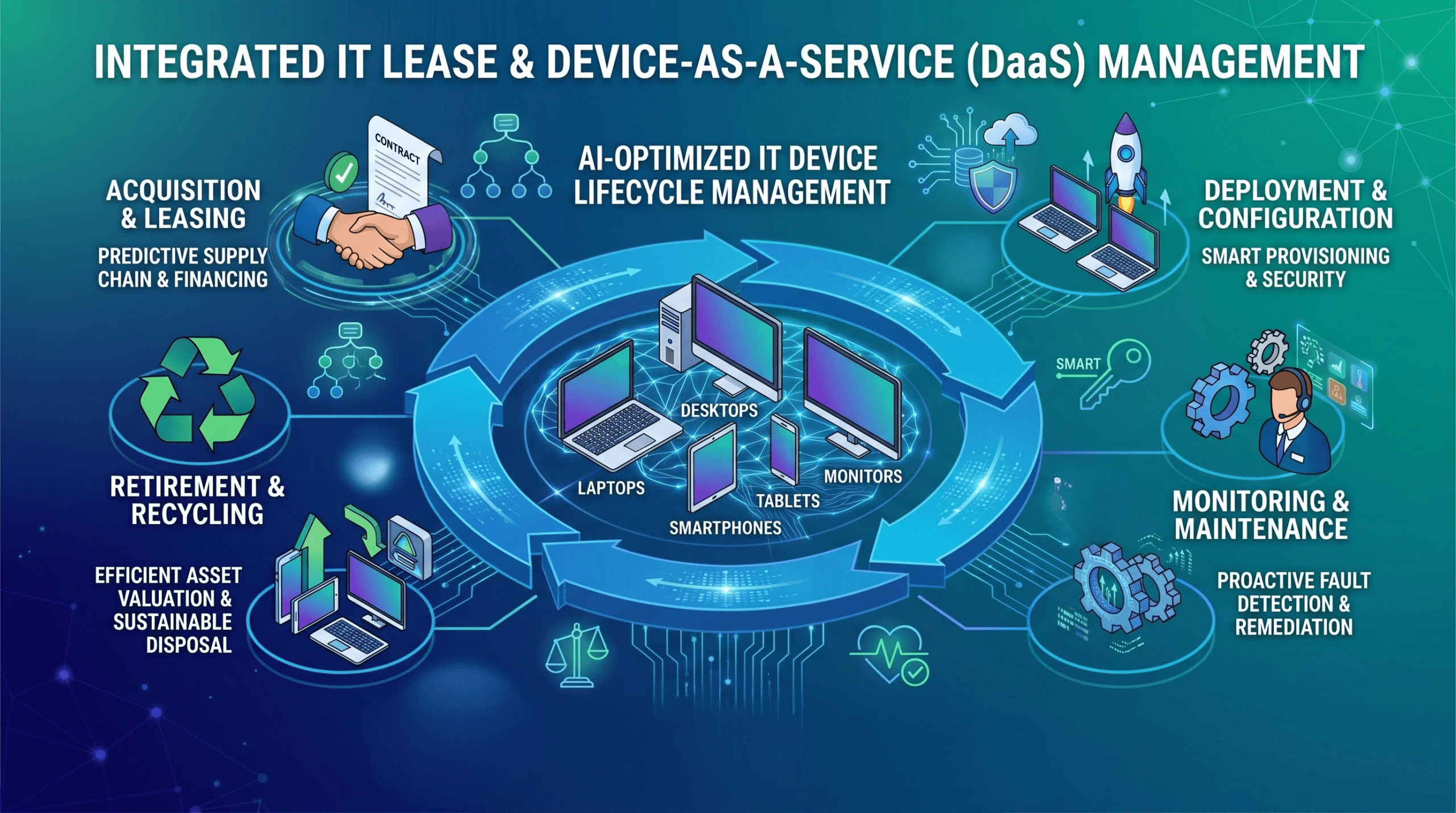
- Device-as-a-Service (DaaS)
- Laptop Leasing and desktop rentals
Swapping upfront capital costs for better cash flow is a smart move, but it creates a massive headache for compliance. It forces you to stop focusing purely on the physical hardware. Instead, you’re suddenly stuck dealing with the legal side of things like tracking brutal return deadlines, messy vendor contracts, and strict financial rules that carry heavy penalties if messed up.
Where Excel Starts to Break Down
Tracking hardware inventory in Excel seems harmless initially. A basic spreadsheet can easily capture asset IDs, employee names, and lease end dates.
But as an enterprise scales, a company managing 3,000 leased laptops suddenly faces thousands of fluid data points: unique vendor terms, mid-term upgrades, early terminations, internal employee transfers, and contract amendments. Spreadsheets are static; a scaling business is dynamic. Very quickly, versions get mixed up, departments work off outdated data, and the business exposes itself to massive financial blind spots.
The Visibility Problem: Siloed Data Across Departments
One of the most expensive hurdles for large enterprises is the absence of a single source of truth:
The Silo Effect:
IT knows where physical assets are deployed. Procurement holds the vendor contracts. Finance tracks the aggregate lease payments. HR tracks employee offboarding.
When your data is scattered across different departments, things get missed. Before you know it, you’re footing the bill for gear tied to ex-employees. Deadlines pass without anyone noticing, and the business just keeps throwing money away on hardware collecting dust in storage.
The Hidden Costs Nobody Talks About
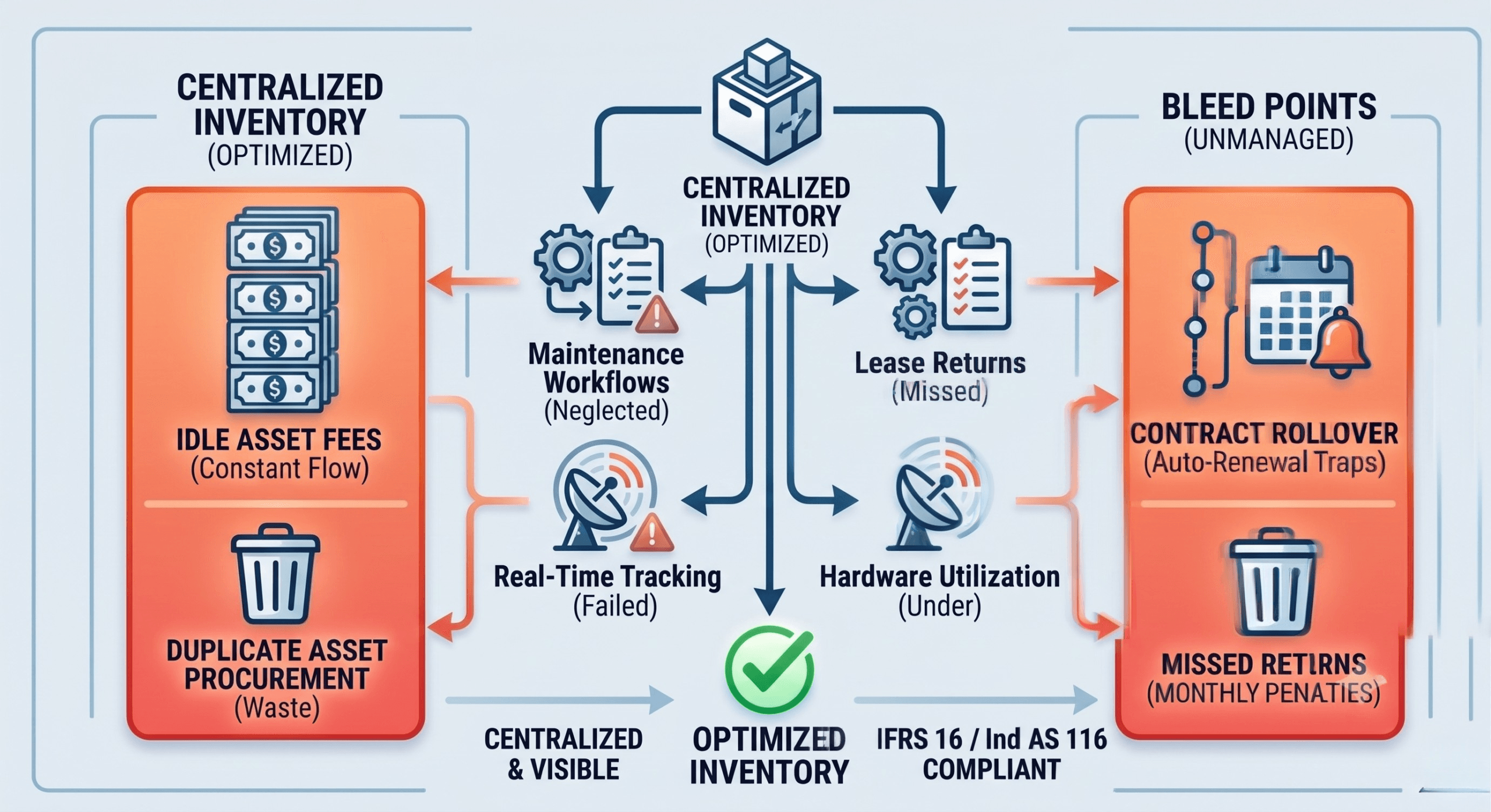
The real financial bleed comes from unmanaged operational expenses that go unnoticed:
- Missed Lease Returns: Failing to ship hardware back within strict windows triggers automated monthly penalties.
- Underutilized Hardware: Paying active leasing fees for devices that aren’t even powered on.
- Duplicate Asset Procurement: Ordering brand-new hardware because IT doesn’t realize returnable inventory is sitting unused in a different office.
- Auto-Renewal Traps: Contracts automatically roll over into expensive new terms because no one received an alert to renegotiate.
Meeting the IFRS 16 and Ind AS 116 Lease Compliance Challenge
Modern asset tracking is now a strict financial reporting mandate. Under global accounting standards like IFRS 16 lease accounting and Ind AS 116, enterprises are legally required to recognize virtually all leased assets directly on their corporate balance sheets. This mandates complex, continuous calculations, including dynamic lease liability tracking, Right-of-Use (ROU) asset valuation, and meticulous amortization schedules.
Trusting a manual spreadsheet for this is a massive gamble. A single wrong keystroke or a broken formula will wreck your balance sheet and cause a nightmare during your next audit.
Why Traditional ITAM Alone Is No Longer Enough
Many companies look to their existing IT Asset Management (ITAM) or Hardware Asset Management (HAM) tools. While these platforms excel at monitoring hardware lifecycles and mapping device allocations, they possess a massive blind spot.
Standard ITAM tools just aren’t designed to touch things like lease contracts, rental timelines, or international accounting rules. Because of that, your data stays split down the middle IT tracks the physical laptop in one system, while Finance buries the actual bill in another.
The Solution: Unified IT Lease Management (ITLM)
- True corporate asset governance requires bridging the gap between physical hardware tracking and corporate financial obligations. Organizations need an ecosystem that seamlessly unifies three distinct pillars:
- IT Asset Management (ITAM): For physical device tracking and user allocations.
- IT Lease Management (ITLM): is all about vendor contracts and tracking renewals so deadlines don’t slip past.
- Financial Compliance: fixes the compliance headache by automating lease liability calculations, which gives you audit-ready IFRS 16 or Ind AS 116 paperwork without the manual effort.
The ezAtlas NEXUS ITLM Approach
ezAtlas NEXUS ITLM was developed from the ground up to solve the operational friction of lease-heavy corporate environments. By blending robust IT Asset Management with deep financial Lease Management, it eliminates the need for disparate spreadsheets.
Whether your organization is tracking leased laptops, corporate printers, enterprise servers, or entire data center infrastructures, ezAtlas NEXUS provides a single, unified command center.
By putting IT, Finance, Procurement, and Compliance teams on the exact same page, ezAtlas NEXUS transforms asset management from an expensive guessing game into a predictable strategic advantage.
Ready to move beyond the limitations of spreadsheets? Discover how ezAtlas NEXUS ITLM protects your bottom line, streamlines your compliance, and unifies your IT lifecycle