Blogs

Your SAP Isn't Slow. Your Invoices Are.
Fix This Silent Bottleneck in Enterprise Finance wit AI Automation
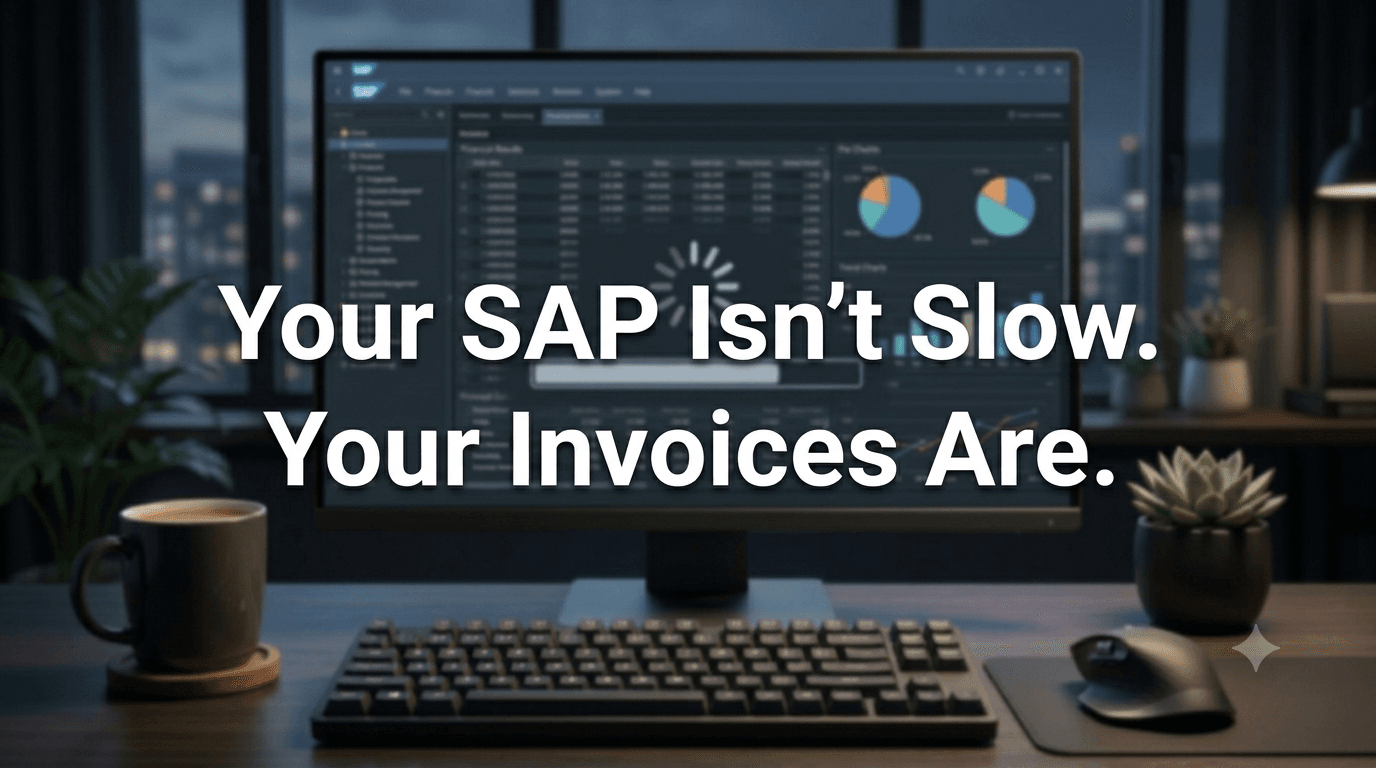
When an enterprise invests in a tier-one ERP system like SAP, the leadership team expects a certain level of operational velocity. You poured resources into a world-class system of record to achieve absolute data integrity, streamlined supply chains, and granular financial visibility.
You certainly didn’t buy SAP so your highly paid financial analysts could spend their afternoons manually keying invoice numbers, chasing down missing purchase orders, or untangling line-item pricing discrepancies over email.
Yet, in many enterprise finance departments, daily reality tells a very different story. It looks like an analog anchor dragging down a digital powerhouse. Invoices flood into the business from a chaotic mix of supplier channels—scattered across corporate email addresses, physical mailrooms, vendor portals, and messaging apps. Once they arrive, they stall out in a sluggish, manual game of telephone.
The core system isn’t the problem. SAP is executing exactly what it is told to do. The bottleneck is the sheer amount of human friction and administrative noise that occurs before that data ever reaches your ERP—a gap that is best bridged by dedicated SAP Invoice Automation.
The Hidden Drain of Manual Accounts Payable
When you look at the ledger, the true cost of manual accounts payable is rarely aggregated into a single line item. Instead, these costs are scattered across the department. Implementing Accounts Payable Automation fixes this by fundamentally changing how you track, verify, and process incoming liabilities. Without a digital workflow, enterprise finance teams usually run into three major roadblocks:
- The Direct Cost of Manual Processing: Industry benchmarks indicate that manually shepherding a single enterprise invoice from receipt to payment resolution costs an average of ₹250. When multiplied across thousands of vendors and monthly cycles, this represents a massive operational tax.
- The Opportunity Cost: While your AP team is stuck manually transcribing line items, auditing tax codes, and managing repetitive data entry, they are completely blocked from executing high-value strategic work. They aren’t analyzing cash flow trends, negotiating better terms with critical suppliers, or optimizing working capital.
- Systemic Risk: The lag of manual routing introduces severe systemic risk. Slow processing causes companies to miss out on early-payment discounts. Additionally, delayed payments cause vendors to follow up constantly, put accounts on hold, and create unnecessary tension with the suppliers keeping production moving.
Breaking Down the Numbers: The Impact of Automation
The business case for transitioning to comprehensive Enterprise Invoice Automation is stark and quantifiable:
- 80% Cycle-Time Reduction: Invoices that used to take weeks to route, verify, and approve are resolved in days—or even minutes.
- 95% Extraction Accuracy: Advanced artificial intelligence and data ingestion engines eliminate human keyboard errors, identifying duplicate invoices and tax mismatches before they cause a downstream audit nightmare.
- ₹1000+ Saved Per Invoice: Moving from a traditional workflow to an automated setup slashes processing costs from ₹250 down to well under ₹40 per invoice.
Evolution of the Invoice Lifecycle
The Fragmented Legacy Flow
Consider the journey of a standard, manual invoice. It starts when a vendor emails a PDF to a procurement manager, where it routinely stalls in an inbox for three days. The manager eventually forwards it to a shared AP email address. An accounts payable clerk downloads it, opens a secondary screen in SAP, and begins manually typing headers, line-item quantities, and unit prices.
If it’s a purchase order (PO) invoice, the clerk must manually cross-reference the goods receipt in the system. If there is a price mismatch of even a few dollars, the invoice goes into an exception pile. Emails are sent to the original buyer. Voicemails are left. Meanwhile, weeks pass, the invoice goes past its due date, and the vendor starts calling your procurement directors to pause upcoming shipments.
The Touchless, Intelligent Flow
Now contrast that with an automated paradigm powered by modern Invoice Automation Software. The invoice arrives at a central email gatekeeper. It becomes entirely touchless. Incoming invoices go straight to an automated ingestion system where OCR technology extracts the layout into digital data fields. The platform then handles the three-way match by validating the billing data directly against SAP purchase orders and warehouse receipts. If everything matches within your approved tolerances, the invoice posts straight to your ERP automatically, achieving a completely touchless process. If a genuine exception occurs, like an unexpected shipping fee the platform automatically isolates that specific discrepancy and routes it via internal workflows to the correct manager for an instant mobile approval.
Inside the Intelligent 8-Step Lifecycle
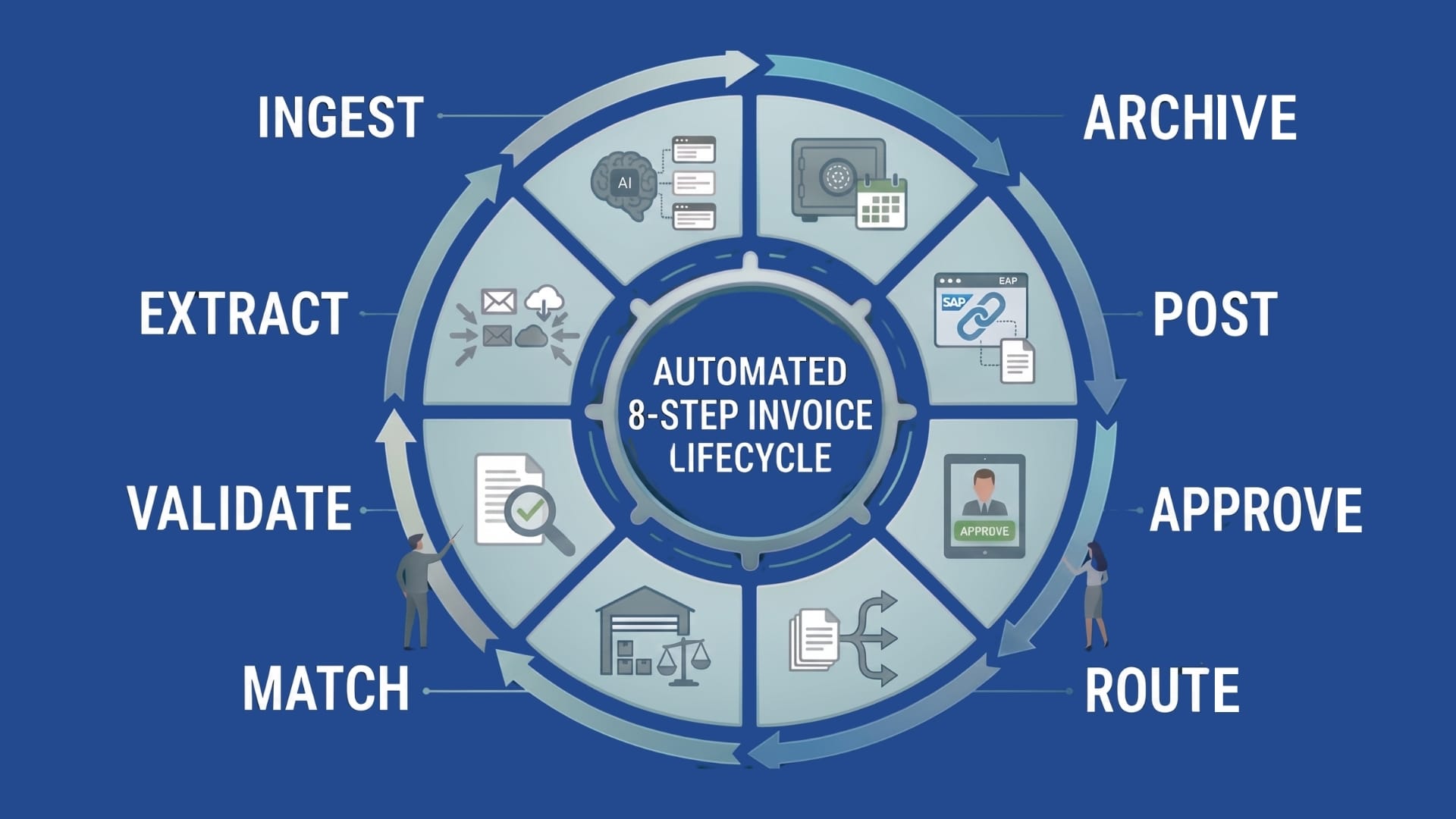
Achieving this touchless environment requires a continuous, intelligent pipeline that sits perfectly atop your SAP infrastructure:
- Ingest: Consolidates invoice data across all intake channels—AP inboxes, legacy scans, and external supplier platforms—into a single digital queue.
- Extract: AI algorithms instantly map and extract header-level details and deep line-item tables with pinpoint precision.
- Validate: Automatically audits the extraction against internal data compliance rules, flagging duplicate invoices and cross-checking tax registrations.
- Match: Conducts automated 3-way matching, aligning vendor data with purchase orders and warehouse receiving receipts directly inside your network.
- Route: Isolates exceptions or unmatched line items and automatically passes them to designated team members based on built-in matrix logic.
- Approve: Managers quickly review, add context, and sign off on invoices through intuitive web portals or mobile devices.
- Post: Fully verified invoices transfer straight into SAP with zero manual effort, keeping your core system of record completely accurate.
- Archive: Every invoice is stored alongside a complete timeline of actions and approvals, giving your compliance team an instant, reliable history for future audits.
Turning AP into a Value Center
The transition away from manual invoice handling is not simply an exercise in cost-cutting. It is an opportunity to transform your entire accounts payable architecture into a highly strategic function.
With end-to-end automation, you gain a real-time, unobstructed view of your financial liabilities. Leadership no longer has to make cash-preservation decisions using three-week-old data. Real-time accuracy means you routinely secure early-payment discounts, cut down the time spent handling vendor disputes, and allow your team to focus on building a more resilient operations model.
Stop letting analog invoices slow down your enterprise digital investments.
Optimize Your Enterprise Workflows
Discover how ezAtlas bridges the operational gap between your incoming billing streams and your native SAP architecture to realize true, scale-ready touchless processing.
More Case Studies